Almost everyone who bakes cookies at home has experienced it at least once. You follow the recipe exactly, mix the dough carefully, shape the cookies evenly, and slide the tray into the oven with confidence. Yet when the timer rings, the results are disappointing.
Some cookies are too dark on the bottom, others are pale on top, and the centers may be either underbaked or dry and crumbly. The difference between a perfect cookie and a failed batch often comes down to one critical factor: oven temperature.
The best oven temperature for cookies is not just a random number printed in a recipe. It controls how fast the dough spreads, how sugar caramelizes, how moisture evaporates, and how structure sets inside the cookie.
Even a difference of 15 degrees can change a cookie from soft and chewy to thin and crispy. Temperature affects the balance between the outside browning and the inside texture more than any other single variable.
Learning how oven temperature influences cookies gives you control instead of guesswork. Once you understand why a certain temperature works and how different cookies behave at different heat levels, you can adjust with confidence.
This guide explains everything from the science of cookie baking to the practical temperature ranges that deliver consistent, bakery-quality results at home.
Why Oven Temperature Matters More Than You Think for Cookies

Oven temperature directly controls how quickly a cookie transforms from raw dough into a finished baked good. When cookie dough enters the oven, several things happen almost at the same time. Butter and fats begin to melt. Sugars dissolve and start caramelizing.
Eggs set and form structure. Flour proteins develop just enough to hold the cookie together. Water from butter, eggs, and the dough itself begins to evaporate as steam. All of these changes are highly temperature-sensitive.
If the oven temperature is too low, the fats melt and spread before the structure has time to set. This creates thin, flat cookies with greasy edges and weak centers. The cookies may bake through eventually, but they often lack depth of flavor and proper texture.
If the temperature is too high, the outside of the cookie sets and browns before the inside finishes baking. The result is cookies that look done on the outside but remain raw or doughy in the center.
Temperature also determines how quickly browning occurs. Browning is driven by caramelization and the Maillard reaction.
Both processes accelerate rapidly as temperature rises. A cookie baked at 375°F will brown far faster than one baked at 325°F, even if the baking time is shortened. This affects not only appearance, but also flavor.
The best oven temperature balances all of these reactions. It allows enough spread for proper shape, enough time for moisture to escape gradually, and enough heat for even browning without burning. Getting this balance right is the foundation of great cookie baking.
Standard Best Oven Temperature for Most Cookies
For the vast majority of classic cookies, the best oven temperature falls between 350°F and 375°F. Within this range, 350°F is considered the universal standard for evenly baked cookies with balanced spread, color, and texture.
This temperature gives the dough enough time to spread naturally before the structure sets and allows the sugars to brown slowly and evenly.
At 350°F, cookies generally bake through without scorching on the bottom. The center sets gently, producing chewy or soft-centered textures depending on the dough.
Chocolate chip cookies, sugar cookies, oatmeal cookies, peanut butter cookies, and many drop-style cookies perform exceptionally well at this temperature.
The slightly higher end, 375°F, is often used when a crisper edge and faster bake are desired. At this temperature, the outside sets more quickly, limiting spread and creating firmer edges with softer centers if the bake time is carefully controlled.
This range works well for thin cookies, shortbread-style doughs, and cookies where structure matters more than spread.
Temperatures below 325°F are rarely ideal for cookies because they encourage excessive spread and pale color.
Temperatures above 400°F are usually too aggressive and lead to burned bottoms before the centers are done. The 350°F to 375°F range remains the safest, most reliable zone for most cookie recipes.
How Cookie Texture Changes With Different Oven Temperatures
The same cookie dough can produce dramatically different textures depending on oven temperature. Understanding this helps you tailor results to your preference instead of relying blindly on a single number.
At 325°F, cookies spread more because fats melt slowly and structure takes longer to set. The final product is often wide, thin, and softer throughout, with pale color and less pronounced flavor.
This temperature is useful for very thick or heavily loaded cookies, but it can produce underwhelming results for standard drop cookies.
At 350°F, most cookies achieve a balanced profile. Spread is controlled, edges bake evenly, centers set without drying out, and browning develops properly. This is the sweet spot for chewy cookies with crisp edges.
At 375°F, cookies bake faster with less overall spread. Edges firm up quickly, and the center remains slightly softer if timed correctly. This temperature enhances caramelized flavor but increases the risk of overbrowning if the tray is left too long.
At 400°F and above, cookies set almost immediately on the outside. This creates very crisp edges and can trap moisture inside, leading to burnt exteriors and doughy centers. Only very specific cookie styles benefit from this range.
By adjusting oven temperature within this spectrum, you control whether cookies turn out chewy, crispy, cake-like, or thin and crunchy.
What Happens Inside Cookie Dough as Temperature Rises
Cookie dough undergoes a chain of physical and chemical changes as it heats. Each stage responds differently to temperature.
First, fats such as butter and shortening begin to melt between 90°F and 95°F. As the dough warms, these fats liquefy and allow the cookie to spread. Lower oven temperatures prolong this stage and increase spread.
Next, sugars dissolve and begin caramelizing as temperatures climb above 320°F. Caramelization deepens flavor and color. If this happens too early at very high heat, the cookie darkens before the interior is baked.
Egg proteins begin to coagulate around 160°F. This is when structure starts forming. A correctly timed structure-setting phase is essential for holding the cookie together without drying it out.
Starch gelatinization from flour occurs between 140°F and 160°F. This thickens the dough and stabilizes the crumb.
Water inside the dough turns to steam above 212°F. This steam lifts the cookie slightly and contributes to lightness. If the oven is too hot, steam escapes violently and can cause surface cracking or excessive spreading at the wrong time.
The best oven temperature synchronizes all of these processes so that spread, structure, moisture loss, and browning occur in harmony instead of competing with each other.
Why 350°F Is the Gold Standard for Cookies
The popularity of 350°F is not accidental. This temperature represents an ideal balance where most cookie doughs behave predictably.
Butter melts at the right speed. Eggs set without tightening too quickly. Sugars caramelize at a measured pace. Steam escapes gradually instead of explosively.
At this temperature, cookies spread just enough to form a pleasing shape without becoming flat. The interior remains moist and tender while the edges develop light crispness. Browning occurs evenly across the surface rather than concentrating on the bottom.
350°F also offers a wide margin for error. A cookie left in for an extra minute may become slightly crispier, but it is unlikely to burn instantly. This makes it forgiving for home bakers who may not monitor the oven continuously.
For these reasons, most professional bakeries that specialize in soft and chewy cookies default to 350°F unless a specific outcome requires adjustment. If you ever encounter a recipe with a questionable temperature, returning to 350°F is usually the safest correction.
How Oven Type Influences the Best Temperature for Cookies
Not all ovens behave the same, even when set to the same temperature. Conventional ovens rely on natural air movement, while convection ovens circulate hot air with a fan. This difference directly affects cookie baking.
In conventional ovens, 350°F remains the standard target for most cookies. Heat is less aggressive, so cookies bake steadily.
In convection ovens, hot air moves continuously across the cookies. This increases heat transfer efficiency and speeds up baking. Because of this, the recommended temperature is usually reduced by 20°F to 25°F.
For example, if a conventional recipe calls for 350°F, a convection oven should be set to around 325°F to 330°F to avoid overbrowning.
Ignoring this adjustment is one of the most common causes of burned cookie bottoms and overly dark edges in convection ovens.
Gas ovens also behave differently from electric ovens. Gas ovens tend to be slightly more humid due to combustion moisture, which can slow surface browning.
This sometimes allows cookies to tolerate slightly higher temperatures without burning, but temperature consistency can vary more than in electric ovens.
Understanding your oven type helps you fine-tune the “best” temperature rather than relying on a single universal number.
How Oven Temperature Affects Cookie Spread
Spread is one of the most noticeable temperature-controlled behaviors in cookies. The lower the oven temperature, the longer fats remain in liquid form before structure sets. This allows cookies to flow outward and become thinner.
At higher temperatures, the exterior sets quickly. This limits spread and produces thicker cookies. This is why some bakers intentionally increase temperature slightly when they want thicker, bakery-style cookies.
However, excessive heat sets the outside too fast and traps steam inside. This can cause cookies to puff in the center and collapse as they cool, leading to uneven texture.
Temperature also interacts with chilling. Chilled dough spreads more slowly because the fats start cold. At 350°F, chilled dough holds shape better than room-temperature dough. At 375°F, even chilled dough may spread rapidly at the edges.
Understanding how heat and fat behavior work together allows you to control cookie shape with far greater accuracy.
How Browning Depends on Oven Temperature
Browning depends strongly on temperature because both caramelization and the Maillard reaction accelerate rapidly above 330°F. The speed of these reactions doubles with relatively small temperature increases.
At 325°F, cookies may bake through before significant color develops. The final cookie is often pale with mild flavor.
At 350°F, browning occurs gradually. This produces a golden color and balanced sweetness.
At 375°F, browning intensifies quickly. Flavor deepens, but timing becomes more critical to avoid bitterness from overcaramelized sugars.
At temperatures above 400°F, browning becomes aggressive and can overpower the cookie’s flavor before the interior finishes baking.
The goal is to choose a temperature that allows the interior to finish baking at nearly the same moment that ideal surface color is achieved. For most cookies, that moment aligns very well with 350°F.
Best Oven Temperature for Different Types of Cookies
Not all cookies behave the same in the oven. Each type of cookie has a different fat ratio, sugar content, moisture level, and structural makeup. Because of this, the “best” oven temperature changes slightly depending on the cookie style.
Chocolate chip cookies perform best at 350°F. This temperature allows butter to melt gradually, sugar to caramelize evenly, and the centers to stay soft while the edges turn crisp.
Raising the temperature to 375°F produces thicker cookies with firmer edges but increases the risk of dark bottoms.
Sugar cookies are more sensitive to heat because they are often rolled and cut. They bake best at 325°F to 350°F. Lower heat preserves sharp edges and prevents excessive browning before the interior sets.
Oatmeal cookies benefit from 350°F to 375°F. The higher temperature helps moisture escape from the oats while creating deeper caramel flavor.
Shortbread cookies prefer 325°F. These high-butter cookies brown too fast at higher temperatures and lose their delicate crumb.
Peanut butter cookies typically bake best at 350°F. This temperature keeps them soft inside and prevents dry, crumbly texture.
Understanding cookie category allows you to fine-tune temperature instead of forcing every recipe into one rigid number.
Chewy vs Crispy Cookies and Temperature Control
Texture preference plays a major role in temperature choice. The same dough can produce chewy cookies or crispy cookies depending almost entirely on oven heat.
For chewy cookies, the ideal temperature is 350°F. At this temperature, moisture escapes slowly, allowing the inside to stay soft. The structure sets without over-drying the crumb.
For crispy cookies, a slightly higher temperature of 375°F to 390°F works better. The faster evaporation of moisture produces thinner cookies with firm, crunchy edges and dry interiors.
Lower temperatures such as 325°F produce soft, pale cookies that lack crispness but retain moisture. This range works for cake-style cookies but not for crisp varieties.
Higher temperatures above 400°F dry the surface too quickly and risk burning before proper internal baking occurs.
Temperature sets the moisture-loss speed. Slow moisture loss equals chewy texture. Fast moisture loss equals crisp texture.
How Rack Position Changes Effective Baking Temperature
Rack placement changes how heat interacts with cookies even at the same set temperature.
The middle rack is ideal for most cookies because it balances radiant heat from the top and bottom. At 350°F on the middle rack, cookies develop evenly without bottom scorching or top overbrowning.
The lower rack receives stronger bottom heat. At the same temperature, cookies placed here may brown faster underneath while remaining pale on top. This position is better suited for pizzas and bread than cookies.
The upper rack receives intense top heat. At 350°F, cookies on the upper rack can brown prematurely on the surface before the centers are baked.
When baking multiple trays at once, rotating the trays halfway through baking ensures uniform exposure to airflow and radiant heat.
Temperature alone does not guarantee even baking. Rack position determines how that temperature is delivered to the cookie surface.
How Convection Ovens Change the Best Temperature for Cookies
Convection ovens circulate hot air using a fan. This dramatically increases heat transfer efficiency. Because of this, the best cookie temperature in a convection oven is usually 20°F to 25°F lower than in a conventional oven.
If a recipe calls for 350°F in a conventional oven, the correct convection setting is 325°F to 330°F. Without this reduction, cookies brown too fast on the outside while remaining underbaked in the center.
Convection also reduces baking time by 10 to 20 percent. Cookies that normally bake for 12 minutes may finish in 9 to 10 minutes under convection.
Convection is excellent for baking large batches of cookies at once because airflow equalizes temperature across multiple trays. However, improper temperature adjustment is a common cause of burned cookie bottoms and overly dark edges.
If your oven has a convection option, always lower the set temperature and shorten bake time.
Common Oven Temperature Mistakes That Ruin Cookies
One of the biggest mistakes is setting the temperature too high to bake faster. High heat browns the surface before the cookie interior has time to set. This produces dark edges with raw centers.
Another mistake is skipping proper preheating. Cookies placed into a partially heated oven experience chaotic heat shifts that distort shape and texture.
Using an inaccurate oven thermostat is also a major problem. Many home ovens run 15 to 30 degrees hotter or colder than the displayed temperature. An external thermometer is essential for accurate baking.
Overcrowding trays blocks airflow and changes the effective temperature around the cookies. This leads to uneven browning even at the correct temperature setting.
Failing to adjust temperature for convection mode is another common cause of burned cookies.
How to Test and Verify Your Oven Temperature for Cookies
The most accurate way to confirm your cookie temperature is by using a standalone oven thermometer.
Place the thermometer on the middle rack and preheat the oven to 350°F for at least 20 minutes. If the thermometer does not match the set temperature within 10 to 15 degrees, your oven needs recalibration.
For best accuracy, test multiple locations inside the oven. Back corners often run hotter than front corners.
If your oven consistently runs hot, reduce the bake temperature by the measured difference rather than guessing. Temperature accuracy is the foundation of consistent cookie texture and color.
Professional Bakery Temperature Strategies for Cookies
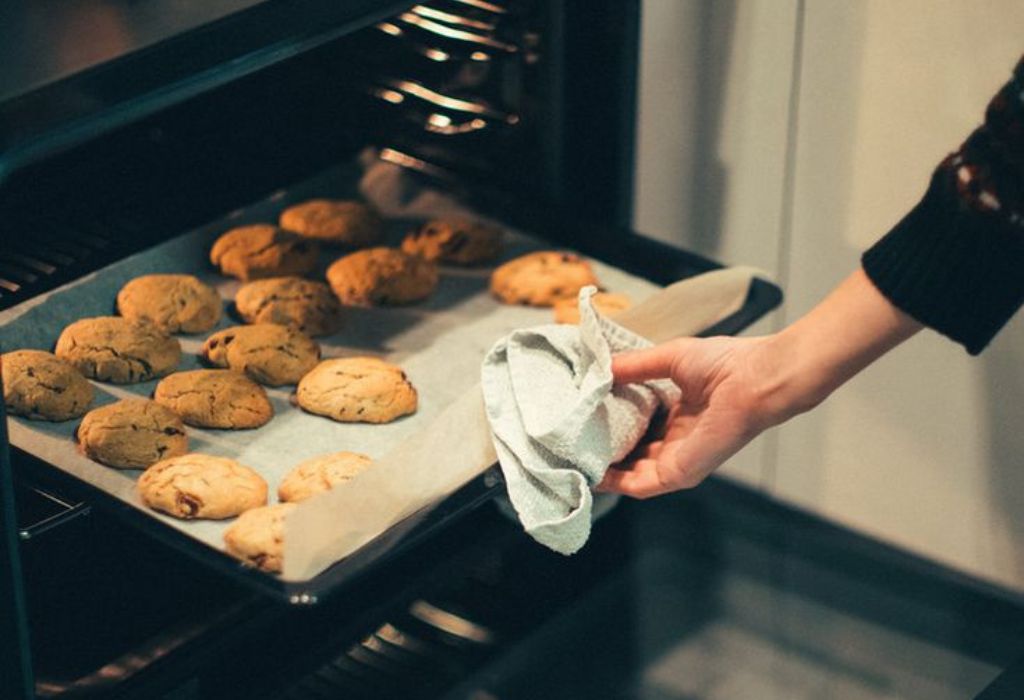
Professional bakeries rarely guess temperatures. They use strict thermal control to produce the same cookie every day.
Most bakeries bake soft cookies at 340°F to 350°F, allowing slow moisture loss and controlled spread. Crispy cookies are baked closer to 375°F for faster dehydration.
Commercial ovens are calibrated weekly. Tray rotation is routine. Dough temperature is also controlled because warmer dough spreads faster even at the same oven temperature.
Many bakeries chill cookie dough before baking. Chilled dough spreads slowly, allowing thicker cookies even at standard 350°F.
These professional strategies prove that temperature control is more important than almost any other baking variable.
Best Oven Temperature for Cookies FAQs
What is the best oven temperature for most cookies?
The best temperature for most cookies is 350°F because it produces even browning, proper spread, and soft centers.
Can I bake cookies at 375°F?
Yes, 375°F works for crispier cookies but requires close timing to avoid burning.
Why do my cookies burn at the bottom?
This usually happens due to high bottom heat, dark pans, or placing trays too low in the oven.
Is 325°F too low for cookies?
325°F can work for soft or thick cookies but often causes pale color and excessive spreading.
Should I change temperature for convection ovens?
Yes, reduce the temperature by 20°F to 25°F when using convection mode.
Does chilling cookie dough affect baking temperature?
Yes, chilled dough spreads less and may need slightly longer bake time at the same temperature.
Why are my cookies raw in the middle?
This usually happens when temperature is too high, causing the outside to set before the center bakes.
Do different cookies need different temperatures?
Yes, shortbread prefers lower heat, while oatmeal and crispy cookies tolerate higher heat.
How do I know if my oven temperature is accurate?
Use a standalone oven thermometer to verify real internal temperature.
Should I rotate cookie trays while baking?
Yes, rotating trays halfway through baking helps prevent uneven browning.
Conclusion
The best oven temperature for cookies is the key factor that controls texture, spread, moisture, and flavor.
While many recipes vary, 350°F remains the most reliable temperature for most cookie types because it allows balanced spreading, even browning, and soft centers with crisp edges.
Lower temperatures produce paler, softer cookies with more spread, while higher temperatures create faster browning and crisper textures but increase the risk of burning.
Oven type also plays an important role. Convection ovens require a temperature reduction of about 20°F to prevent overbaking. Rack placement, dough temperature, tray spacing, and cookware material further influence how that temperature performs in real conditions.
Once you understand how oven temperature controls fat melting, sugar caramelization, and moisture loss, cookie baking becomes predictable instead of trial and error. With correct temperature control, you can consistently achieve bakery-quality cookies at home.

I’m Emma J. Caldwell, the founder, lead writer, and home-cooking enthusiast behind KitchenGuideCo.com. With a background in culinary arts and over a decade of cooking experience in both professional and personal kitchens, I created this platform to demystify recipes, offer smart kitchen gadget reviews, and guide readers through meal prep with confidence and clarity.