Many home cooks love the warmth and classic feel of a wooden chopping board, and it becomes a trusted part of their kitchen routine over time.
After preparing a meal, the quickest instinct is to place everything inside the dishwasher because it promises strong heat and high pressure for fast cleaning.
That moment of convenience often raises a small question about whether a wooden board can withstand the dishwasher’s harsh environment.
People who have used wooden boards for years have stories about how their boards slowly changed shape after being washed the wrong way.
When someone opens the dishwasher and finds their board slightly bent or cracked, the confusion quickly turns into regret because wooden surfaces behave differently than plastic or metal.
This early damage pushes many users to search for a clear answer about whether wood and dishwashers are compatible.
Dishwashers operate with temperatures and moisture levels that feel completely normal for dishes, yet they react intensely with natural wood fibers. The constant hot water spray, detergent and drying cycles can weaken a board long before the damage becomes visible.
This makes it important to understand how the dishwasher environment affects wood internally, even when the outside looks fine.
Kitchen hygiene is another concern that makes people consider using the dishwasher for wooden boards. They assume the high heat will kill germs, but the truth is more complicated because damaged wood can trap moisture and bacteria more easily.
Learning the right way to wash and maintain a wooden chopping board helps avoid unnecessary damage while keeping food preparation safe and clean every day.
What Happens Inside a Dishwasher That Affects Wooden Boards
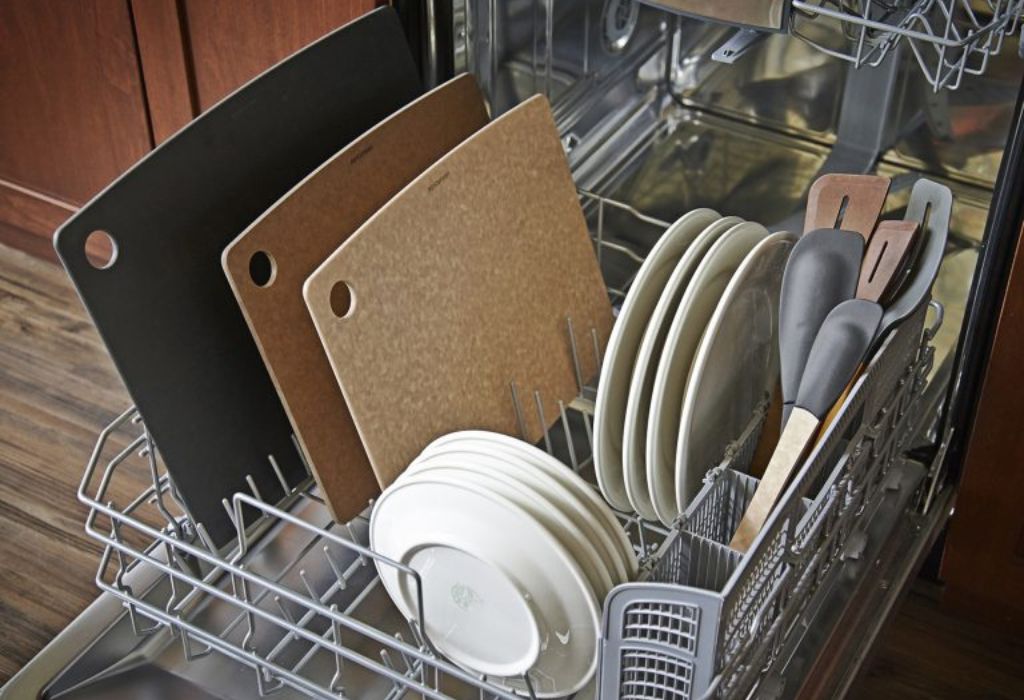
Dishwashers operate with a combination of heat, water pressure and detergent that is perfect for cleaning hard, nonporous surfaces.
Wooden chopping boards absorb moisture much more deeply than other materials, so the constant spray of hot water can cause rapid swelling. This sudden expansion begins to stress the internal fibers long before any visible sign appears.
The heated dry cycle inside a dishwasher exposes wood to temperatures that can cause quick evaporation of the absorbed moisture.
When water leaves the wood too fast, the fibers contract in an uneven pattern that eventually leads to warping. This creates a curved or twisted shape that makes the board difficult to use on a flat surface.
Dishwasher detergents are formulated to cut through grease and food residue with strong chemical agents. These chemicals easily strip away the natural oils that protect wooden boards from drying out.
Once the protective layer is gone, the surface becomes rough and more vulnerable to cracking.
Steam inside the dishwasher builds during each cycle and remains trapped until the door opens. This steam penetrates wood fibers more deeply than liquid water because it enters through even the smallest pores. Over time this leads to internal damage that cannot be repaired simply by sanding or oiling.
High pressure water jets can strike wooden boards from all angles, creating repeated impact on the surface. This constant pressure can weaken glue joints in boards made from multiple pieces. When the joints loosen, the board may begin to split or separate near the edges.
Temperature changes inside the dishwasher shift quickly between hot water cycles and cooler rinse stages.
Wood reacts strongly to these fluctuations because it expands when heated and contracts when cooled. Repetition of this cycle eventually leads to micro cracks that grow larger with each wash.
Wooden boards that remain inside the dishwasher for long periods after the cycle ends continue absorbing moisture from leftover steam.
This extra moisture layer increases the risk of mold growth on boards that do not dry evenly. That is why leaving a wooden board in a closed dishwasher makes the problem even worse.
Why Wooden Chopping Boards Are Not Considered Dishwasher Safe
Wood is a naturally porous material that absorbs water quickly, and dishwashers provide exactly the environment that triggers maximum expansion.
When a board swells too fast, the fibers push against each other until the structure begins to bend. This bending becomes more visible after only a few cycles.
Manufacturers warn that wooden chopping boards should be hand washed because the glue used in many boards weakens under heat and moisture.
When the glue breaks down, the pieces of wood that were bonded together start separating. This separation creates uneven surfaces that are unsafe for cutting.
Prolonged exposure to moisture makes wood more likely to crack because water sits inside the grain. Once cracks form, they expand every time the board goes through hot and cold phases. Eventually the cracks reach the surface and become visible splinters.
Wood also loses its protective oil coating during dishwasher cycles because detergents are designed to remove all types of oils.
Without this layer, the board dries out much faster and becomes rough to the touch. This roughness makes cutting less stable and more uncomfortable.
The drying cycle inside a dishwasher causes wood to shrink rapidly as moisture evaporates. Uneven shrinkage between different parts of the board creates tension that leads to warping. A warped board does not lay flat on a counter, making it unsafe for slicing or chopping.
Dishwashers are designed for nonporous materials that do not react to chemicals or heat. Wood behaves differently because it is organic and continues to expand and contract based on temperature changes. These reactions make wood incompatible with dishwasher environments.
Bacteria can enter wooden chopping boards through cracks created by heat damage. When the board dries too quickly, it traps moisture inside deeper layers where bacteria can grow. This creates hygiene issues that become difficult to fix with normal cleaning.
How Dishwasher Heat and Moisture Damage Wooden Boards Over Time
Repeated heating cycles cause wooden boards to expand and contract frequently. This movement weakens the wood fibers and leads to long term instability. Over time the board begins to show visible signs of stress.
Moisture inside the dishwasher seeps into the pores of the wood and increases internal swelling. When the board dries too quickly during the heated cycle, the moisture inside cannot escape evenly. This uneven evaporation causes cracks to form from the inside out.
End grain wooden boards absorb more water than edge grain boards because the exposed fibers act like small straws.
Dishwashers accelerate this effect and make end grain boards more vulnerable to structural damage. That is why high quality butcher blocks also suffer inside dishwashers despite being thicker.
The protective finish on wooden boards degrades when exposed repeatedly to strong detergent. Without oil or wax coating, the bare wood becomes dry and brittle. This dryness makes the surface more likely to splinter during cutting.
Boards made from multiple pieces of wood rely on strong glue to maintain their shape. Dishwasher heat breaks down these adhesive bonds much faster than normal kitchen use. Once the joints fail, the board begins separating at the edges or in the center.
Steam inside the dishwasher lingers around the board long after the wash cycle ends. This extended exposure continues weakening the fibers, especially near the edges. The outer layers dry first while the inner layers remain moist, creating internal tension.
Constant water pressure striking the board causes erosion of the surface over time. This erosion leads to grooves that trap food particles and make cleaning difficult. Once these grooves form, the board becomes harder to sanitize properly.
Are There Any Types of Wooden Boards That Can Survive Dishwashers
Some high density hardwood boards handle moisture better because their tightly packed fibers absorb water more slowly. These woods include maple, walnut and teak, but even they are not fully safe in dishwashers. Their strength only delays the damage rather than preventing it.
End grain cutting boards are often thicker and more durable, yet they still absorb moisture quickly when exposed to hot water.
Their construction makes them slightly more resistant to cracking, but dishwasher cycles eventually weaken them too. This resistance gives a false sense of security to many users.
Commercial grade wooden boards sometimes receive treatments that increase water resistance.
These treatments protect the surface for a short time, but heavy detergents inside dishwashers strip away the coating. As soon as the coating is gone, the board behaves like untreated wood.
Boards made from a single piece of wood perform better than laminated boards because they do not rely on glue joints. However, single piece boards still warp when exposed to rapid temperature changes. They also develop cracks if moisture enters the deeper layers.
Thicker wooden boards have more material to absorb damage before becoming unusable. This extra thickness slows the rate of warping, but it does not eliminate the risk. Eventually the internal stresses will still change the shape of the board.
Manufacturers of high quality boards almost always advise against using dishwashers regardless of durability. This universal recommendation reflects the long term risks that cannot be avoided. Even premium boards experience damage when exposed to dishwasher cycles.
Rare specialty boards are marketed as dishwasher safe, but most rely on plastic or resin content alongside wood.
These hybrid materials act more like synthetic products than natural wood. Because they are not true wooden boards, they should not be considered typical examples.
Safest Ways to Clean Wooden Chopping Boards Without a Dishwasher
Hand washing a wooden chopping board with warm water and mild soap is the most reliable cleaning method. This approach prevents water from soaking deeply into the wood. It also allows the board to dry slowly and evenly.
A soft sponge helps break down food residue without damaging the surface fibers. Scrubbing in a gentle circular motion keeps the board clean while preserving its natural texture. This method avoids the harsh abrasion caused by dishwasher jets.
Rinsing the board immediately after use prevents stains and odors from sticking. Fresh food residues come off easily because they have not yet soaked into the wood. This reduces the need for heavy cleaning later.
Drying the board upright allows air to circulate around both sides. This balanced airflow prevents one side from drying faster than the other, reducing the risk of warping. A towel can help remove surface water before air drying begins.
Sanitizing a wooden board can be done safely with vinegar or a hydrogen peroxide solution. Both options kill bacteria without harming the wood fibers. These natural sanitizers also help remove smells from garlic and onions.
Avoid soaking wooden boards in water because long immersion causes swelling. Water that seeps deep inside the grains takes a long time to evaporate. This trapped moisture can lead to mold growth.
Using lemon and salt helps remove tough stains while refreshing the surface. The coarse salt acts as a mild exfoliant that lifts debris from the grain. Lemon adds natural antibacterial properties and leaves a fresh scent.
How to Properly Disinfect Wooden Chopping Boards
Hydrogen peroxide is one of the most effective disinfectants for wooden boards. Pouring a small amount onto the surface and letting it sit for a few minutes kills bacteria safely. Afterward the board should be rinsed and left to air dry.
White vinegar can also disinfect wood because its acidity disrupts bacterial growth. Spraying a thin layer across the board covers the entire surface quickly. Vinegar evaporates naturally and leaves the board ready for the next use.
Boiling water helps sanitize wood without exposing it to chemicals. Pouring it slowly over the surface allows heat to penetrate shallow layers. This method should be used sparingly to avoid unnecessary swelling.
Baking soda helps remove stubborn odors trapped in the grain. Sprinkling a small amount on the board and scrubbing gently breaks down smell particles. After rinsing, the surface feels clean and fresh.
Deep cleaning becomes necessary when stains or odors remain after regular washing. Combining vinegar and baking soda creates a mild reaction that lifts debris from the pores. This technique restores the board without needing harsh cleaners.
Wooden boards should be replaced if cracks become deep enough to trap bacteria. No amount of cleaning can sanitize hidden moisture inside these cracks. Replacing a severely damaged board keeps your kitchen safe and hygienic.
Maintaining proper hygiene means cleaning the board after every use. Regular washing prevents bacteria from growing inside the grain. Consistent care helps extend the lifespan of the board.
How to Maintain a Wooden Chopping Board for Long Life
Oiling a wooden chopping board helps restore moisture and protect its surface from drying out. Food grade mineral oil works best because it does not turn rancid. Applying the oil evenly allows it to soak deep into the fibers.
Using board butter, a mixture of beeswax and mineral oil, creates a stronger protective layer. The wax seals the surface while the oil nourishes the wood. This combination helps extend the board’s lifespan significantly.
Boards should be oiled every few weeks depending on how often they are used. Frequent use requires more frequent oiling to keep the surface smooth. A properly oiled board resists stains and odors better.
Small cracks can be repaired by sanding the surface with fine grit sandpaper. This removes rough edges and restores a smooth finish. After sanding, the board should be re oiled to replenish lost moisture.
Avoid placing hot pots or pans on the board because heat damages the fibers. Extreme temperatures cause wood to dry unevenly and form cracks. Using the board only for cutting helps preserve its structure.
Storing wooden boards upright helps prevent moisture buildup underneath. Proper airflow around the edges keeps the board dry and stable. Avoid stacking boards directly on top of each other.
Cleaning the board immediately after cutting prevents deep staining. Foods like berries, garlic and onions can leave strong marks if left too long. Quick cleaning keeps the surface looking fresh.
Can Dishwasher Use Lead to Bacteria Problems on Wooden Boards
Dishwasher damage creates cracks and rough surfaces that trap moisture inside the wood. This trapped moisture becomes a breeding ground for bacteria. Even high heat cannot reach the deepest layers once cracks develop.
Wood naturally contains antibacterial properties, but damaged fibers lose much of this ability. When the structure changes, bacteria can hide inside splintered areas. These hidden pockets cannot be cleaned properly with simple washing.
Comparing dishwasher cleaning to hand washing shows important differences. Hand washing removes surface bacteria without harming the structure of the board. Dishwashers may sanitize temporarily but create long term hygiene risks.
Moisture that enters cracks during a dishwasher cycle does not evaporate evenly. Dark spots sometimes appear where water becomes trapped. These spots indicate deeper bacterial activity that continues even after drying.
Some people assume that high heat kills all bacteria instantly. In reality heat must be consistent and reach deep layers to be effective. Cracked wood prevents heat from penetrating fully and leaves hidden bacteria alive.
Using a damaged chopping board increases the risk of cross contamination. Meat juices and vegetable residue can enter cracks and remain after washing. This contamination affects food safety during future meal preparation.
Maintaining a smooth and well oiled board reduces bacterial growth significantly. A well preserved surface does not trap moisture or food particles. Proper care keeps the kitchen cleaner and safer every day.
Signs Your Wooden Chopping Board Is Ruined by Dishwasher Use
A warped board is one of the first signs of dishwasher damage. The board may rock back and forth when placed on a counter. This uneven surface becomes dangerous for slicing and chopping.
Rough or raised edges indicate that the surface fibers have separated. These edges feel sharp or splintered when touched. Splinters can enter food and create safety concerns.
Dark stains or moisture spots often appear after internal swelling. These stains show that water has reached deeper layers. They can also be a sign of mold growth inside the wood.
Cracks along the grain reveal that the board has expanded and contracted too fast. Small cracks grow larger with each dishwasher cycle. Once they appear, the board cannot be fully restored.
Glue joints loosening at the edges show the board is separating into pieces. This separation occurs most often in laminated boards. Once joints fail, the board becomes unstable during use.
Persistent odors that remain after cleaning indicate trapped moisture. These smells usually come from bacteria growing inside tiny cracks. A board that retains odor should be replaced quickly.
If the surface feels uneven or bumpy, the fibers have swelled and dried unevenly. This texture makes cutting more difficult and less hygienic. A smooth board is always safer and easier to maintain.
Important Care Questions for Wooden Chopping Boards
Can wooden chopping boards handle occasional dishwasher cycles
They may survive one or two cycles but damage begins internally from the first wash. Wood absorbs moisture quickly and weakens long before visible changes appear.
Why do wooden chopping boards crack after being washed in a dishwasher
Dishwasher heat causes rapid expansion and contraction inside the wood which creates stress lines. These stress lines turn into cracks as the board dries unevenly.
Does the high heat of a dishwasher sanitize wooden chopping boards
The heat may sanitize the surface temporarily but cannot reach deep into cracks created by moisture damage. Hidden moisture creates bacterial pockets that remain unsafe.
Will oiling a wooden board protect it from dishwasher damage
Oiling slows moisture absorption but does not stop detergent and heat from entering the grain. The dishwasher still removes oil and weakens the wood.
How long do wooden chopping boards last if washed by hand
With proper maintenance a wooden board can last many years because hand washing protects its fibers. Regular oiling and gentle cleaning help preserve the structure.
Does dishwasher detergent harm wooden chopping boards
Dishwasher detergents strip natural oils from the wood and leave the surface dry and vulnerable. This dryness increases the risk of splintering and cracking.
Why do wooden boards smell bad after dishwasher cleaning
Moisture becomes trapped inside cracks and pores during the wash cycle and dries unevenly. This trapped moisture creates odors caused by bacterial growth.
Are end grain chopping boards safer for dishwashers
They resist cuts better but still absorb moisture faster than other designs. Their construction makes them even more vulnerable to swelling and internal damage.
Can mold grow inside a wooden chopping board after dishwasher use
Yes because moisture trapped deep inside the wood does not evaporate quickly. These damp pockets create an ideal environment for mold growth.
When should a wooden chopping board be replaced
Replace the board if it has deep cracks, warping, persistent odor or mold spots. These signs show internal damage that cannot be repaired safely.
Conclusion
Wooden chopping boards are not built to handle the intense environment of a dishwasher, and repeated exposure leads to swelling, cracking and long term structural damage.
The combination of high heat, strong detergent and heavy moisture affects wood differently from other kitchen materials, and these reactions create hidden weaknesses that shorten the board’s lifespan significantly.
Many people only realize the extent of the damage after their board begins to warp or develop deep cracks that cannot be repaired.
Understanding how dishwashers affect wooden boards helps home cooks make safer and more informed decisions in the kitchen.
Hand washing with mild soap, gentle scrubbing and proper drying protects the natural fibers of the board and ensures it remains safe for preparing food.
Regular oiling and careful maintenance also help preserve the wood and prevent stains, odors and unnecessary wear over time.
Hygiene remains a priority for every kitchen, and wooden boards perform best when their structure stays intact and smooth. As long as you clean and disinfect them correctly, wooden boards remain safe and dependable tools that last for years.
Choosing hand washing instead of dishwashing keeps your board in good condition, maintains food safety and supports long term durability without risking preventable damage.

I’m Emma J. Caldwell, the founder, lead writer, and home-cooking enthusiast behind KitchenGuideCo.com. With a background in culinary arts and over a decade of cooking experience in both professional and personal kitchens, I created this platform to demystify recipes, offer smart kitchen gadget reviews, and guide readers through meal prep with confidence and clarity.